









Astronomers have discovered the first confirmed globular cluster stellar stream outside the Milky Way, opening a new avenue for studying dark matter in distant galaxies. This structure, named “Oyashio” after a cold Pacific Ocean current, was found around the ultra-diffuse galaxy UGC 9050-Dw1, approximately 115 million light-years (35.2 megaparsecs) from Earth. The findings were published in Nature on August 12, 2026.
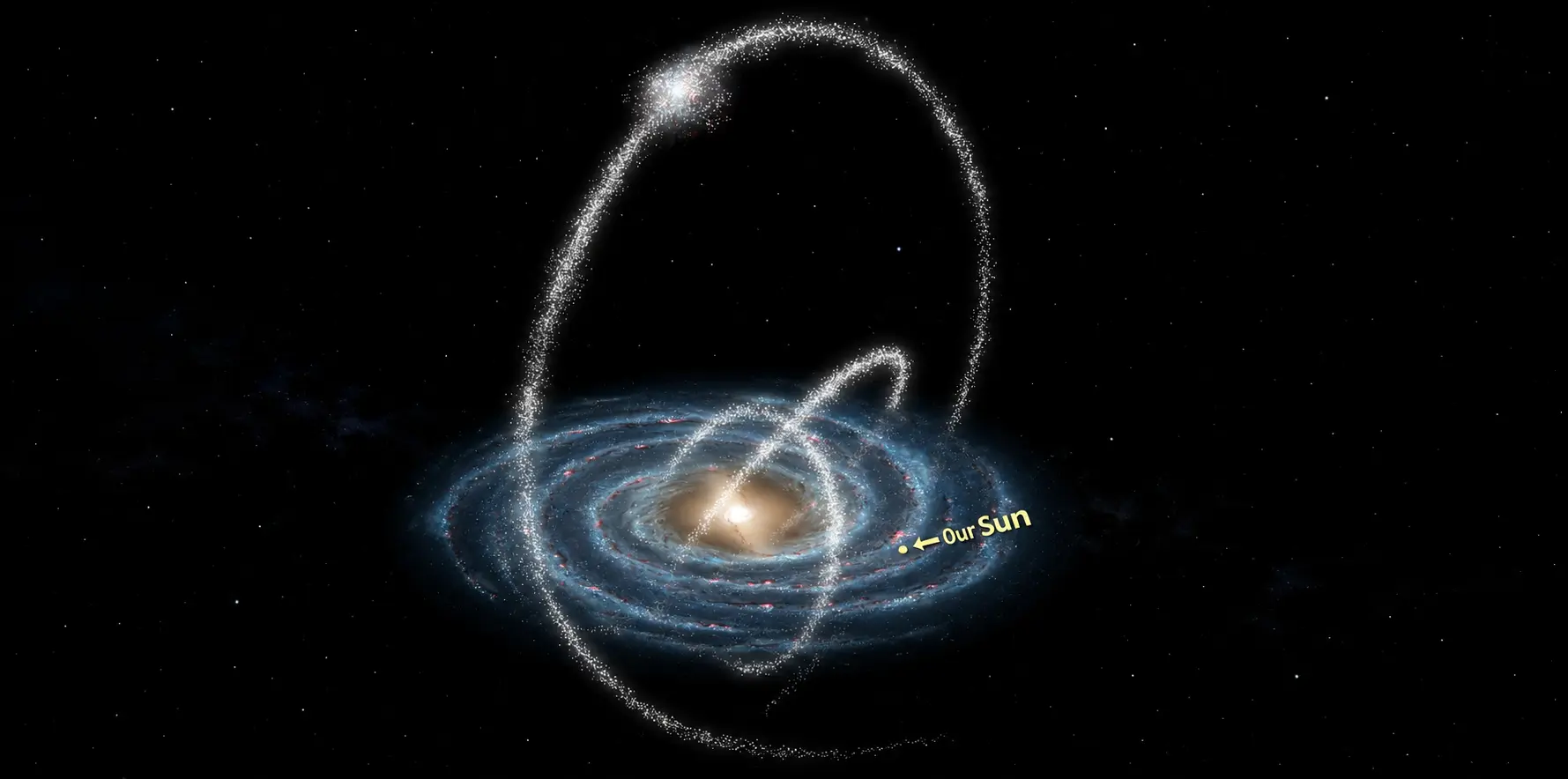
Stellar streams form when a galaxy’s gravity strips stars from an orbiting system, such as a globular cluster. These stars create long, narrow trails that can persist for billions of years. While dozens have been identified within the Milky Way, none had previously been confirmed around another galaxy.
The discovery emerged from archival Hubble Space Telescope observations collected in September 2022 under program ID 16890 by David Sand and Catherine Fielder of the University of Arizona. David Hendel later re-examined these images and noticed a faint arc resembling a stream. Its existence was independently confirmed using additional data from Hubble and the Canada-France-Hawaii Telescope.
UGC 9050-Dw1 is an ultra-diffuse galaxy, meaning it has a stellar mass similar to a dwarf galaxy but is spread across an area comparable to the Milky Way. Its faint background made Oyashio easier to detect.
The stream measures approximately 2 kiloparsecs long and 72.3 ± 8.9 parsecs wide. Its narrow shape strongly suggests an origin from a globular cluster rather than a dwarf galaxy. The stream’s color also closely matches that of its possible parent cluster, further supporting a shared origin. Previous research identified around 52 globular clusters in UGC 9050-Dw1, which collectively produce roughly 20% of the galaxy’s total light.
Researchers systematically ruled out alternative explanations, including a merger tidal tail, stellar shell, gravitational lensing, dust, or a chance alignment.
The team then utilized a new modeling system called the X-Stream sampler, developed by Jacob Nibauer and Sarah Pearson. Since individual stars cannot be resolved at this distance, X-Stream directly analyzes the stream’s integrated light from images, bypassing the need for spectroscopy.
Thousands of simulations placed the original globular cluster’s mass below 2.5 million solar masses with 95% confidence. Researchers estimated UGC 9050-Dw1’s dark matter halo mass at approximately 1.56 × 10¹¹ solar masses and its inner density slope at γ ≈ 0.92, though this measurement remains uncertain.
The study was co-led by Julie Kiel Holm of the University of Copenhagen and Sarah Pearson of the Technical University of Denmark, with Northwestern University’s Tjitske Starkenburg among the international researchers.
Future observatories could significantly expand this research. NASA’s Nancy Grace Roman Space Telescope will offer a field of view roughly 100 times larger than Hubble’s, while Euclid, deeper Hubble observations, the James Webb Space Telescope, and future spectroscopy could identify and confirm more streams.
This discovery means astronomers may finally be able to use stellar streams beyond the Milky Way to investigate galaxy masses, dark matter halos, subhalos, and ultimately, the nature of dark matter itself.