










SpaceX has launched another cargo mission to the International Space Station (ISS), carrying thousands of pounds of supplies and experiments that could help scientists better understand human health and develop new technologies.
The CRS-35 mission lifted off on Tuesday, October 13, at 6:33 a.m. EDT from Cape Canaveral Space Force Station in Florida. A Falcon 9 rocket carried NASA’s Dragon spacecraft, packed with more than 6,300 pounds of cargo.
Along with food, equipment and supplies for astronauts, Dragon is carrying experiments involving artificial retinas, human heart tissue and brain diseases. The spacecraft is also delivering the final pair of solar arrays needed to complete an important power upgrade aboard the ISS.
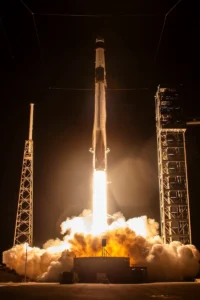
Falcon 9 lifts off at 6:33 a.m. EDT carrying a Dragon capsule with over 6,300 pounds of cargo to the ISS
The ISS Is Getting Its Final Solar Arrays
One of the most important items aboard Dragon is the final pair of Roll-Out Solar Arrays.
The ISS has relied on solar power for decades. However, its original solar panels have gradually lost some efficiency over time. NASA has been installing newer, lightweight solar arrays to increase the station’s electricity supply.
These panels are designed to roll out after installation, making them easier to transport into space.
With the final pair now on its way, NASA is close to completing an upgrade that will help power scientific experiments and daily activities aboard the station.

Long-exposure shot traces the Falcon 9’s glowing arc over the Florida coast
Scientists Are Testing New Ways to Treat Diseases
Some of the most interesting cargo aboard CRS-35 is intended for medical research.
The LambdaVision-1 experiment will explore whether artificial retinas can be manufactured more effectively in space. Artificial retinas could eventually help people affected by certain forms of vision loss.
Another experiment, called Stellar Spheroids, will examine how three-dimensional human heart tissue develops in microgravity.
Researchers are particularly interested in how blood vessel networks form when gravity is no longer affecting cells in the same way it does on Earth.
The MINDS experiment will focus on brain inflammation linked to Alzheimer’s disease, Parkinson’s disease and multiple sclerosis.
Scientists will use brain organoids, which are tiny laboratory-grown models of human brain tissue, to study how cells respond in space.
Meanwhile, ELF-Unconventional Glass 2 will investigate how unusual types of glass form under microgravity conditions.
These experiments may help researchers develop better materials and understand biological processes that are difficult to study on Earth.
Dragon Is Also Carrying Equipment for Future Moon Missions
Not everything aboard Dragon is intended for the space station.
The spacecraft is carrying a collapsible urinal demonstration unit that will support NASA’s Artemis III mission. The equipment will help engineers test waste-management technology for future space exploration.
Dragon is also transporting a large foam container that will eventually bring a damaged part of the station’s Canadarm2 robotic arm back to Earth.
Astronauts replaced the faulty joint during a June 30 spacewalk. Once it returns, engineers will examine it to understand what went wrong.
SpaceX Reuses Its Rocket and Spacecraft
SpaceX continues to rely on reusable spacecraft to carry out NASA’s cargo missions.
The Dragon capsule used for CRS-35 has already flown three times, supporting the CRS-26, CRS-29 and CRS-33 missions.
The Falcon 9 booster was also making its eighth flight. Its previous missions included KF-01, IMAP, NROL-77, GPS III-9, CRS-34, NROL-95 and a Starlink launch. After separating from Dragon, the booster successfully returned to Landing Zone 40 at Cape Canaveral.
The landing demonstrated SpaceX’s ability to recover and reuse major rocket components instead of building a new booster for every launch.

Glowing “space jellyfish” forms in the predawn sky after SpaceX’s CRS-35 launch from Cape Canaveral
When Will Dragon Arrive at the Space Station?
Dragon is expected to reach the ISS on Thursday, October 15, after travelling for approximately 52 hours.
The spacecraft is scheduled to dock automatically at around 11 a.m. EDT at the space-facing port of the station’s Harmony module.
NASA astronaut Anil Menon and Canadian Space Agency astronaut Joshua Kutryk will monitor the arrival.
Dragon will remain attached to the ISS until approximately mid-November. When it returns, the spacecraft will bring back scientific samples, the damaged Canadarm2 joint, a spacesuit and equipment from the station’s water and waste-processing systems.
It will then splash down off the California coast, allowing researchers to collect experiments that need to be examined shortly after returning to Earth.
The CRS-35 mission is another example of how regular cargo flights support research aboard the ISS. While delivering supplies may sound routine, the experiments travelling with Dragon could contribute to future medical treatments, better spacecraft systems and the technologies astronauts will need for longer missions beyond Earth.