








For years, Pakistan’s water crisis was often described as a challenge for future generations. Today, it has become a reality affecting millions of people across the country. Farmers struggle with unreliable irrigation, cities experience severe flooding after heavy rainfall, groundwater levels continue to decline and access to clean drinking water remains a growing concern in many communities.
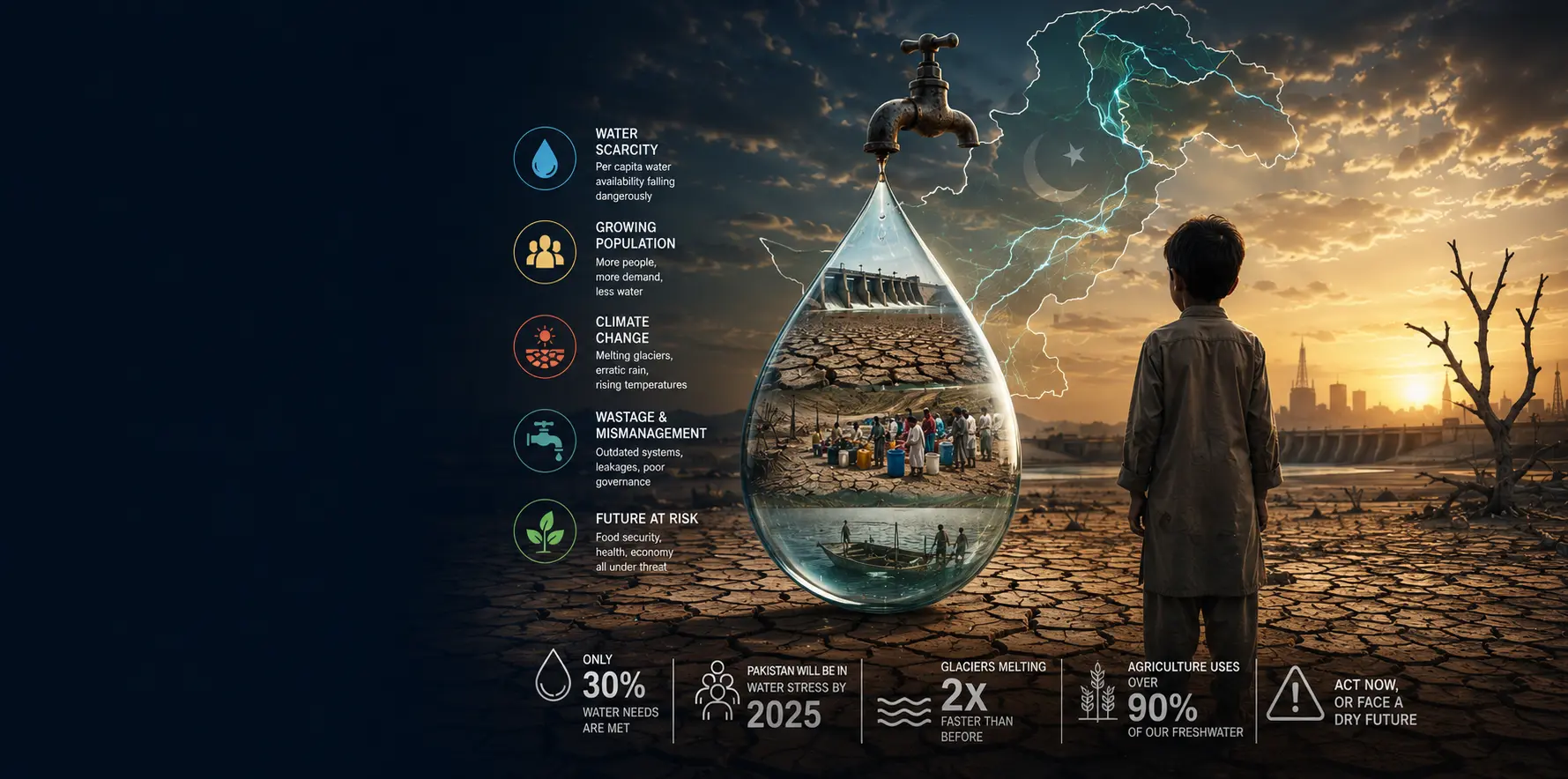
The crisis is far more complex than simply running out of water. It is driven by climate change, inefficient water management, ageing infrastructure, rapid urbanisation, pollution and increasing demand from a growing population. Together, these pressures are pushing Pakistan deeper into water scarcity and placing both economic growth and public well-being at risk.
Pakistan relies heavily on the Indus River system, one of the largest irrigation networks in the world. This vast network supports the country’s agriculture, provides water to major cities and sustains millions of livelihoods. However, dependence on a single river basin also makes Pakistan highly vulnerable to changing weather patterns and climate shocks.
Unlike many countries that rely on multiple river systems, Pakistan’s water security depends largely on the health and stability of the Indus Basin. At the same time, agriculture consumes the overwhelming majority of the country’s freshwater resources, while inefficient irrigation methods continue to waste significant amounts of water. According to the World Bank, poor water management already costs Pakistan an estimated 4% of its GDP every year, highlighting that the issue is as much economic as it is environmental.
Climate change has made this challenge even more unpredictable.
Pakistan is among the countries most vulnerable to climate-related disasters despite contributing only a small share of global greenhouse gas emissions. Rising temperatures are accelerating glacier melt in the north, while warmer air is increasing the intensity of rainfall during the monsoon season. The result is a dangerous cycle where devastating floods and prolonged droughts can occur within the same year.
Recent years have demonstrated how destructive these extremes can become. Heavy rainfall has repeatedly damaged homes, farmland, roads and public infrastructure, while prolonged dry periods have reduced water availability for agriculture and drinking supplies. Climate change is no longer a distant environmental concern—it is directly influencing Pakistan’s economy, food production and public safety.
Agriculture sits at the centre of the crisis.
The sector remains the backbone of Pakistan’s rural economy and depends almost entirely on reliable irrigation. Crops such as wheat, rice, cotton and sugarcane require large volumes of water, yet much of the irrigation network still relies on ageing canals and traditional flood irrigation methods that lose enormous amounts of water through seepage and evaporation.
As water availability becomes more uncertain, farmers face increasing pressure from lower crop yields, changing weather patterns and rising production costs. Because agriculture supports millions of jobs while contributing significantly to exports, improving water efficiency has become essential not only for farmers but for Pakistan’s overall economic stability.
The country’s cities face an equally serious challenge.
Karachi, Lahore, Islamabad-Rawalpindi, Faisalabad, Multan and Peshawar continue to expand rapidly, often faster than their infrastructure can support. During the monsoon season, blocked drainage systems and uncontrolled urban development turn heavy rainfall into widespread flooding. Yet only a few months later, many of these same cities experience water shortages, falling groundwater levels and growing dependence on water tankers.
This contradiction illustrates that Pakistan’s water crisis is no longer limited to rural communities. Urban planning, drainage systems, wastewater treatment and rainwater harvesting will become increasingly important as cities continue to grow.
At its core, the water crisis is also a governance challenge.
Experts have long argued that Pakistan possesses enough knowledge to address many of its water problems, but implementation has often lagged behind planning. Responsibilities are divided among federal, provincial and local institutions, making coordination difficult. At the same time, limited data on groundwater extraction, canal losses, flood risks and urban water demand makes long-term planning more complicated.
Addressing the crisis will require more than emergency responses after floods or droughts. Pakistan needs modern irrigation systems, stronger groundwater regulation, wastewater recycling, improved urban drainage, climate-resilient infrastructure and greater public awareness about water conservation. Water security must be treated with the same urgency as energy security because both are fundamental to the country’s long-term stability.
The encouraging news is that solutions already exist.
Technologies such as drip irrigation, laser land levelling and climate-smart agriculture can significantly reduce water waste while improving productivity. Cities can invest in rainwater harvesting, green infrastructure and modern drainage systems to reduce flood risks. Treated wastewater can be reused for agriculture and industry, easing pressure on freshwater resources, while improved early warning systems can help communities prepare for floods and other climate-related disasters.
None of these solutions will solve the problem overnight. Together, however, they can strengthen Pakistan’s resilience and reduce the long-term economic and social costs of water insecurity.
The coming decade will determine whether Pakistan successfully adapts to its changing water reality. By 2035, water could become one of the defining factors shaping the country’s agriculture, economy, public health and national development. The challenge is immense, but it is not insurmountable.
The real danger is not that Pakistan lacks water. It is that the country delays managing one of its most valuable resources until the cost of inaction becomes far greater than the cost of reform.