







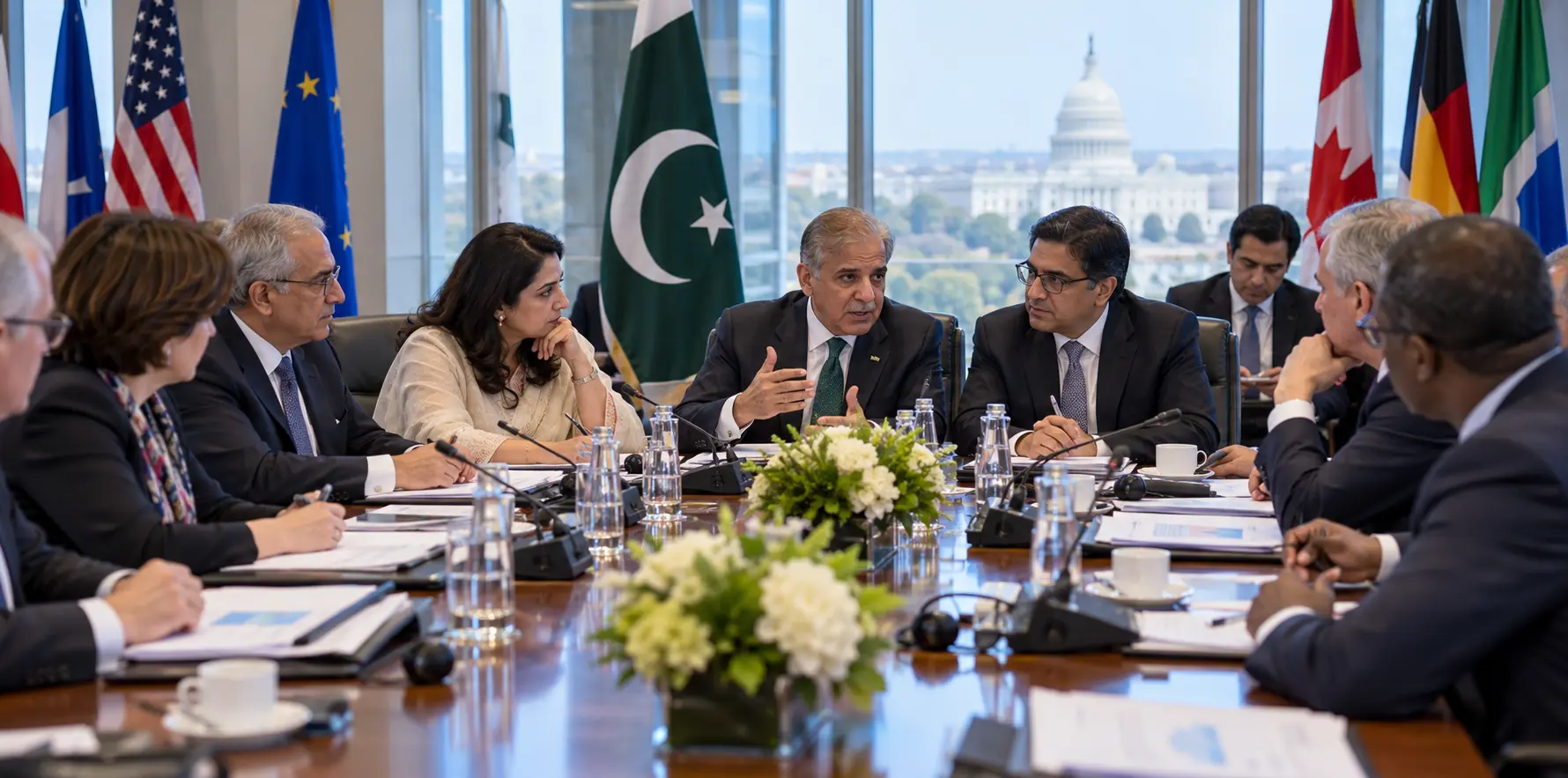

Pakistan is set to assume the chairmanship of the Boards of Governors of the World Bank Group and the International Monetary Fund (IMF) in 2027, marking its return to the position after 74 years. The development gives Islamabad a prominent role in international financial discussions at a time when developing economies face mounting debt, financing constraints and economic uncertainty.
Federal Minister for Economic Affairs Ahad Khan Cheema was formally announced as the incoming chair during the plenary session of the 2026 World Bank-IMF Annual Meetings in Bangkok, Thailand, on October 16.
According to Pakistan’s Ministry of Economic Affairs, the appointment marks the country’s first chairmanship of the two institutions’ Boards of Governors since 1953.
Ahad Cheema Prepares for 2027 Chairmanship
Following the announcement, Cheema, who also serves as Pakistan’s governor to the World Bank Group, held meetings with senior officials to discuss preparations for the upcoming term.
He received a briefing from the World Bank Group’s Corporate Secretariat on the responsibilities associated with the chairmanship. He also met Aradhana Kumar-Capoor, vice president and corporate secretary of the World Bank Group, to discuss institutional coordination and administrative support.
Cheema subsequently met Carlos Carvallo Spalding, governor of the Central Bank of Paraguay and outgoing chair of the Boards of Governors. Their discussions focused on the responsibilities of the position, institutional priorities and preparations for the transition.
The meetings represent an early step towards Pakistan assuming its responsibilities in 2027.
What Does the World Bank-IMF Chairmanship Mean?
The Boards of Governors are the highest decision-making bodies of the World Bank Group and the IMF, comprising representatives appointed by member countries.
Their responsibilities include major institutional decisions concerning governance, membership and financial arrangements. The chairmanship provides a platform for facilitating discussions and coordinating proceedings involving member governments.
For Pakistan, the position offers an opportunity to participate more visibly in conversations concerning development financing, economic stability and international financial cooperation.
However, the chairmanship should not be confused with executive control over either institution. It does not give Pakistan unilateral authority over IMF lending programmes, World Bank financing decisions or the economic policies of member countries.
Its importance lies primarily in international representation, institutional engagement and the opportunity to contribute to discussions shaping global financial priorities.
Pakistan Calls for Stronger Voice for Developing Countries
During the annual meetings, Cheema emphasised the importance of strengthening representation for developing economies within international financial institutions.
He called for more effective and predictable development financing, closer coordination among multilateral development institutions and greater mobilisation of private investment to support sustainable economic growth.
These priorities are particularly relevant for countries struggling to finance infrastructure, climate adaptation, education and other long-term development needs while managing debt obligations.
Pakistan has itself faced significant economic pressures, including external financing requirements, fiscal constraints and repeated dependence on international financial assistance.
The forthcoming chairmanship therefore comes at a time when the country has direct experience with many of the challenges confronting developing economies.
Why the Appointment Matters for Pakistan
The announcement carries diplomatic significance because Pakistan will hold a position it last occupied more than seven decades ago.
The role could provide greater visibility for Islamabad in international economic discussions and create opportunities for engagement with finance ministers, central bank governors and development institutions.
It also comes as Pakistan seeks to expand investment, strengthen economic partnerships and improve its international financial standing.
However, the appointment does not automatically guarantee additional loans, investment commitments or preferential treatment from either institution.
Any economic benefits would depend on separate financing agreements, policy decisions, investor confidence and Pakistan’s domestic economic performance.
A New Opportunity in Global Economic Diplomacy
Pakistan’s return to the chairmanship in 2027 represents a notable development in its relationship with the world’s leading multilateral financial institutions.
The government has pledged to use the position to encourage constructive dialogue, strengthen cooperation and advocate a more responsive international financial system.
The challenge will be translating that diplomatic visibility into meaningful engagement on issues affecting developing countries, particularly access to financing, sustainable growth and economic resilience.
For Pakistan, the 2027 chairmanship is an opportunity to participate in shaping important global economic conversations. Its lasting significance will depend on how effectively the country uses that platform during its term.