







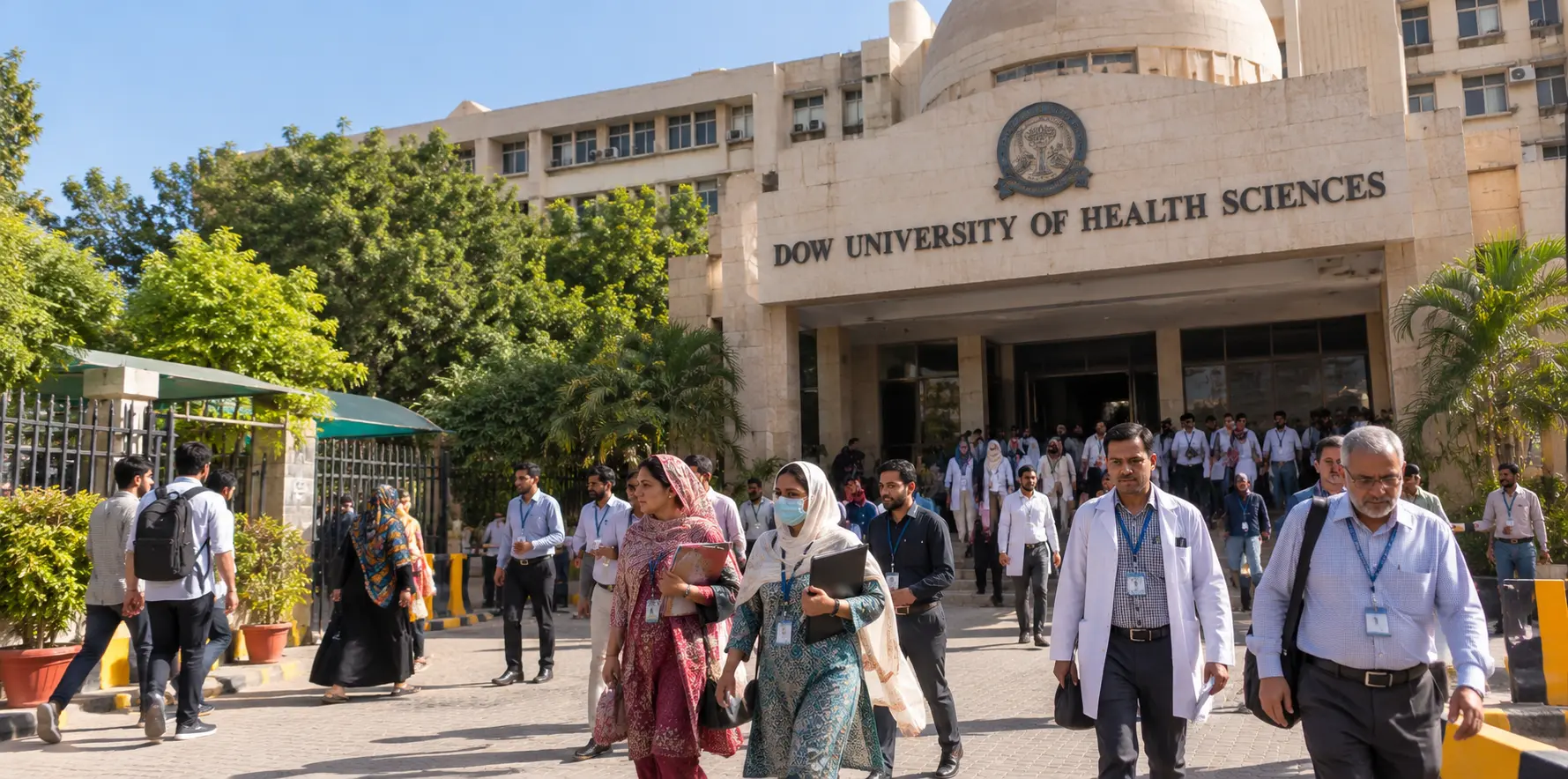

Dow University of Health Sciences (DUHS) in Karachi has dismissed 27 employees after discovering that their educational documents were fake. However, the university has verified the degrees of fewer than half its employees, raising concerns about its recruitment and verification process.
The matter came before the Sindh Assembly’s Public Accounts Committee (PAC) on Tuesday. The meeting, chaired by Nisar Ahmed Khuhro, reviewed the university’s audit reports for 2024 and 2025.
The committee directed Dow University to recover the salaries paid to the 27 dismissed employees. It also ordered all public universities in Sindh to submit reports on the verification of their employees’ educational qualifications.
Over 3,400 Employees Still Await Degree Verification
Dow University currently has 5,350 employees. However, the administration has completed degree verification for only 1,945 staff members.
This leaves more than 3,400 employees whose educational documents have yet to be verified. The university discovered the 27 fake-degree cases during the completed verification process.
However, officials have not established whether additional fake qualifications exist among the remaining employees.
The audit reports also raised concerns about the university’s failure to verify degrees during recruitment. According to the committee, the administration had not properly responded to earlier audit queries.
University Spends Rs 7.36 Million on Verification
Dow University’s Director of Finance, Zainul Abideen Shah, informed the committee that the institution had outsourced degree verification to a private company.
The university awarded HRSG a contract worth Rs 7.36 million to carry out the process through the Higher Education Commission (HEC). Meanwhile, Vice-Chancellor Nazli Hussain told lawmakers that more than 70% of academic doctors’ degrees had already been verified.
She added that verification of the remaining qualifications was underway.
The committee stressed the need to complete the process and ensure that public universities maintain accurate employee records.
Dow University’s Rs 26 Billion Annual Budget
The PAC also reviewed the university’s finances, including its annual budget, income and student fees.
According to Finance Director Zain ul Abideen Shah, Dow University operates with an annual budget of Rs 26 billion. The institution generates approximately Rs 25 billion through academic services, radiology, laboratory services and other activities. Of this amount, around Rs 4.5 billion comes from student fees.
Vice-Chancellor Nazli Hussain said the university offers more than 300 open-merit seats. Students admitted through the self-finance category pay approximately Rs 500,000 annually. Meanwhile, open-merit students pay Rs 60,000 per year.
International students pay between $10,000 and $18,000 annually, according to fee structures determined by the Pakistan Medical and Dental Council (PMDC).
PAC Raises Concerns Over Civil Hospital Karachi
The committee also discussed conditions at Dr Ruth Pfau Civil Hospital Karachi.
Nisar Ahmed Khuhro expressed dissatisfaction with the hospital’s condition despite the Sindh government’s allocation of billions of rupees for free medical treatment.
Civil Hospital Karachi is a major public teaching hospital affiliated with Dow University of Health Sciences. The hospital has approximately 1,900 beds and provides medical services to thousands of patients.
In August 2017, the Sindh government renamed the facility after Dr Ruth Pfau in recognition of her contributions to healthcare in Pakistan.
Khuhro questioned why the hospital continued facing problems despite receiving substantial government funding.
PAC Orders Salary Recovery and Verification Reports
The Public Accounts Committee has directed Dow University to recover the salaries paid to employees dismissed over fake degrees.
It has also instructed public universities across Sindh to submit reports detailing the verification status of their academic and administrative staff. For Dow University, the immediate task is completing checks on the more than 3,400 employees whose qualifications remain unverified.
The findings have raised concerns about recruitment procedures and the importance of checking educational credentials before appointing staff.
The committee’s directions now place responsibility on university administrations to complete the pending verification process and address the irregularities identified during the audit.