







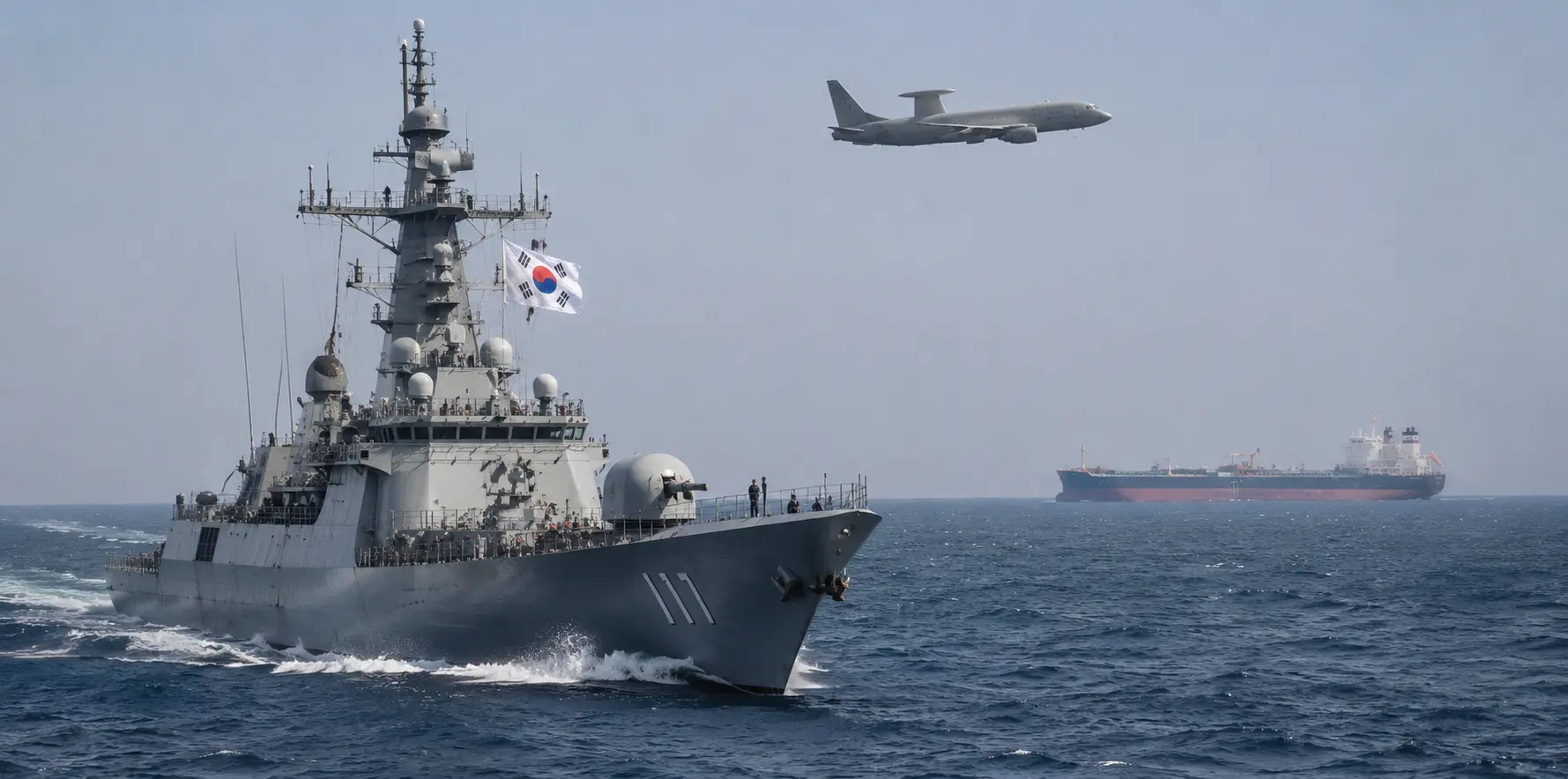

South Korea is expanding its military presence near the Strait of Hormuz as security concerns threaten one of the world’s most important shipping routes. The country’s defence ministry has announced plans to deploy maritime patrol aircraft and an explosive ordnance disposal team to waters near the strategic passage. Seoul will also expand the operational area of its Cheonghae anti-piracy naval unit, which currently operates south of Oman. The decision reflects growing concern over maritime security and the risks facing commercial shipping in the Middle East.
South Korea Strait of Hormuz Mission Expands
South Korea’s defence ministry confirmed that the government had decided to expand the operational area of the Cheonghae naval unit. The deployment will include maritime patrol aircraft and specialists trained to identify and safely handle explosive threats.
The Cheonghae unit has traditionally supported anti-piracy operations and the protection of commercial vessels in nearby waters. Its expanded mission will focus on helping maintain safe navigation near the Strait of Hormuz.
However, officials have not announced the exact number of personnel, aircraft or vessels involved. The ministry has also not provided a detailed deployment schedule.
The announcement does not establish that South Korean forces will participate in offensive military operations against Iran or any other country.
Strait of Hormuz Remains Vital to Global Energy Supplies
The Strait of Hormuz connects the Persian Gulf with the Gulf of Oman and the wider Arabian Sea. It serves as a major route for international oil and liquefied natural gas shipments.
Disruptions in the waterway can affect energy supplies, shipping costs and international trade. Even temporary restrictions may increase uncertainty for energy-importing countries.
South Korea has significant economic interests in maintaining secure maritime routes. Its industrial economy depends on international trade and imported energy, making shipping security an important national concern.
The expanded naval mission therefore reflects both regional security considerations and the country’s broader economic interests.
Patrol Aircraft and Explosives Teams Support Maritime Safety
Maritime patrol aircraft can help monitor shipping activity, identify potential threats and improve situational awareness across large areas of water.
Explosive ordnance disposal specialists are trained to assess and handle dangerous explosive devices. Their expertise may become important when vessels or maritime routes face suspected explosive threats.
Together, these capabilities could support safer navigation and improve coordination during security incidents.
However, the defence ministry’s announcement does not specify the precise operational responsibilities of the newly deployed teams. Their activities will depend on mission instructions and security conditions.
Cheonghae Unit Takes on Wider Security Responsibilities
The Cheonghae naval unit has operated in waters near the Arabian Peninsula as part of South Korea’s efforts to protect commercial shipping.
Its anti-piracy mission has involved maritime surveillance, security operations and support for vessels travelling through important trade routes.
Expanding its operational area allows Seoul to respond to security concerns closer to the Strait of Hormuz without necessarily establishing an entirely new naval mission.
The decision also demonstrates how maritime security operations can adapt when regional threats change.
Nevertheless, the announcement does not confirm that the unit will escort every commercial vessel or guarantee unrestricted passage through the strait.
Regional Conflict Increases Pressure on Shipping Routes
The decision comes amid continuing tensions involving Iran, Israel and the United States. The conflict has raised concerns about maritime threats and the safety of commercial vessels travelling through the Gulf region.
For shipping companies, security uncertainty can affect route planning, insurance arrangements and operating costs.
Energy markets are also sensitive to developments near Hormuz because the waterway connects major Gulf producers with international buyers.
South Korea’s expanded mission is intended to contribute to maritime security during this period of uncertainty.
However, the presence of additional military assets does not by itself resolve the political disputes affecting regional stability.
Maritime Security Becomes an International Priority
South Korea’s decision illustrates the wider international importance of keeping commercial shipping routes secure.
Countries far from the Middle East can still experience the economic consequences of disruptions in the Gulf. Higher freight costs, delayed deliveries and energy supply uncertainty can affect industries and consumers worldwide.
For South Korea, protecting maritime access supports economic stability and the movement of essential imports.
The mission may also provide opportunities for coordination with other countries conducting maritime security activities in nearby waters. However, the defence ministry has not announced specific new multinational arrangements.
South Korea Seeks to Protect Trade Amid Regional Uncertainty
The expansion of the Cheonghae unit represents a practical response to growing maritime security concerns near the Strait of Hormuz.
By deploying patrol aircraft and explosive ordnance disposal specialists, Seoul aims to strengthen surveillance and support safer navigation through a strategically important region.
The mission’s effectiveness will depend on operational coordination, changing security conditions and the ability of commercial vessels to navigate safely.
South Korea’s decision demonstrates how instability in the Middle East can influence security policies thousands of kilometres away. Protecting maritime trade has become an economic and strategic concern for countries that depend on uninterrupted global shipping.