







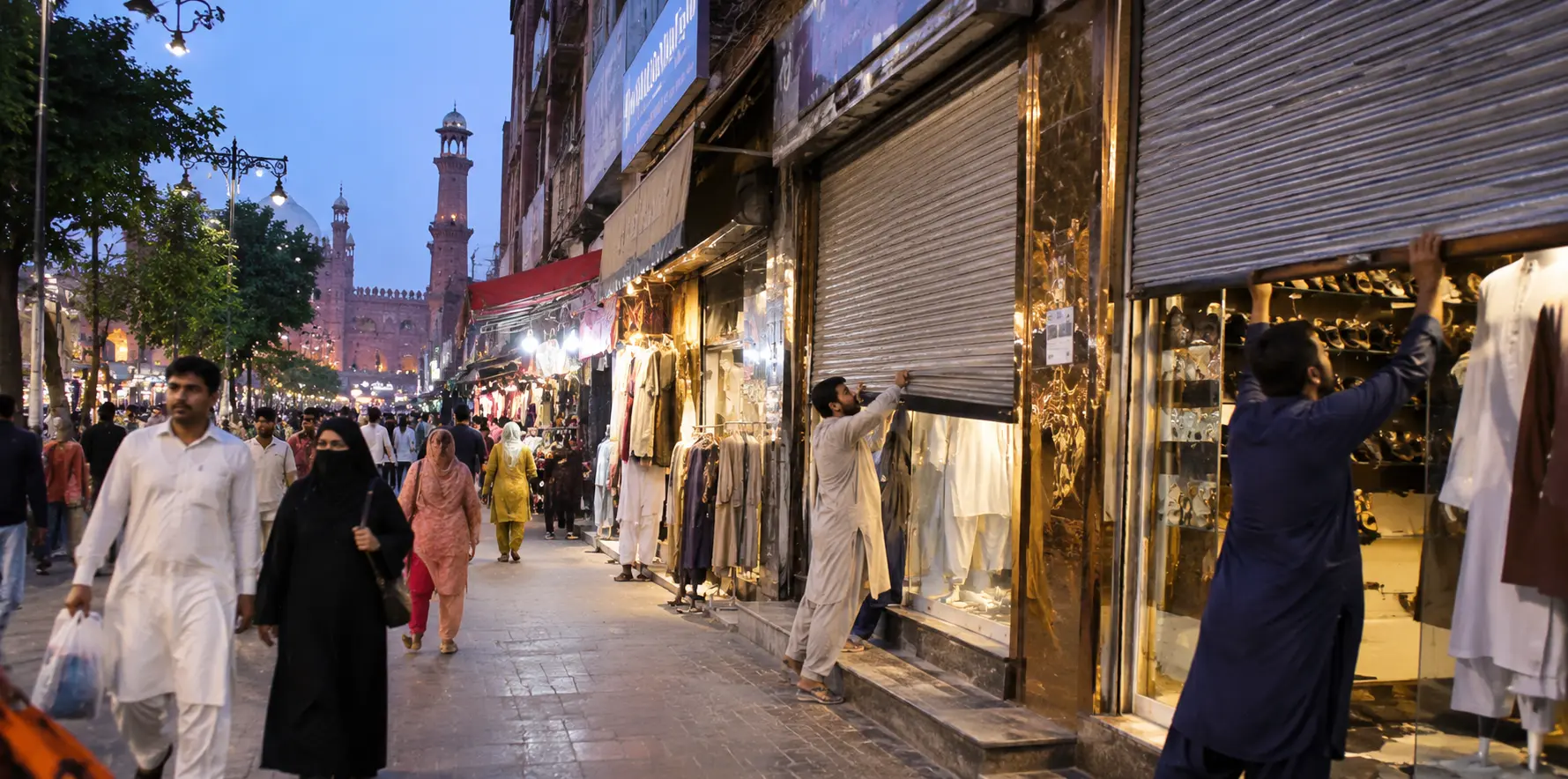

Pakistan’s early market closing policy has been linked to a 42% decline in daily retail transactions, raising concerns about its impact on businesses and consumers. A new study by research firm Ipsos, presented by the Chainstore Association of Pakistan, found that shorter trading hours have affected sales, profitability and shopping habits. However, evidence of significant energy savings remains limited.
Retailers Report Falling Sales and Profits
The study found that average daily transactions per shop declined from 86 to 50 after the restrictions. Retail operating hours also fell from 11.2 to 9.6 hours daily. Footwear businesses experienced particularly sharp declines, with transactions dropping from 85 to 38. The proportion of retailers describing their sales as good decreased from 79% to 34%, while those reporting high profitability fell from 67% to 26%.
Energy Savings Remain Uncertain
The government introduced early market closures in April to conserve electricity during the Middle East energy crisis. However, only 41% of surveyed retailers reported lower utility bills. In Punjab, Islamabad and Balochistan, where the 9pm rule remained applicable during the survey, that figure was just 31%. Although 56% believed the policy achieved its energy-saving objective, the findings do not establish how much electricity was actually conserved.
Consumers Struggle With Shorter Shopping Hours
The research covered 300 retailers across 53 markets and shopping centres in 10 cities, alongside 1,046 consumers. Among shoppers, 53% said finding time to shop had become harder, while 37% reported a worse shopping experience. Average monthly shopping trips declined from 9.4 to 8.7. Women reported a 19% reduction in shopping visits, compared with 3% among men.
Businesses Call for Policy Review
Half of surveyed retailers opposed early closures, while 32% supported them. Businesses have responded by opening earlier, expanding online sales and reducing staffing in some cases. The study also examined international energy-saving policies, identifying alternatives such as peak-hour tariffs and efficiency measures. Several industry stakeholders recommended extending market hours to 10pm or 11pm. Sindh and Khyber-Pakhtunkhwa lifted their restrictions in May, while other regions maintained the 9pm rule during the survey period. The findings raise questions about balancing electricity conservation with economic activity, although transaction declines alone do not establish equivalent revenue losses.