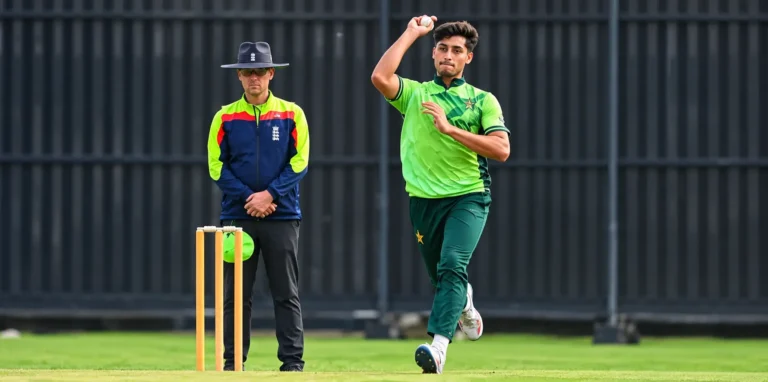










Pakistan’s Under-19 cricket team has reached the final of the ACC Men’s U19 Asia Cup 2026 after defeating Bangladesh by nine wickets in a commanding semifinal performance in Oman. Fast bowler Rizwanullah delivered a career-defining spell, claiming five wickets for just 30 runs before Pakistan’s opening batters completed a comfortable run chase. The defending champions secured victory with more than 28 overs remaining, extending their unbeaten run in the tournament. The result has also set up a highly anticipated final against India on November 14, giving Pakistan an opportunity to defend their continental title.
Pakistan U19 Asia Cup Final Spot Secured in Oman
Pakistan faced Bangladesh in the first semifinal at the Al Amerat Cricket Ground in Muscat on November 12. Bangladesh won the toss and elected to bat, hoping to establish a competitive total in the knockout encounter. However, Pakistan’s pace attack quickly disrupted their plans. Bangladesh lost two early wickets and struggled to establish lasting partnerships against disciplined bowling. Despite resistance from opener Abdullah Al Muhi, the batting lineup collapsed for 138 in 31.4 overs. Pakistan then reached 141-1 in just 21.5 overs, completing a nine-wicket victory. The convincing result reflected the team’s effectiveness in both departments, with the bowlers creating the advantage and the batters ensuring Bangladesh had no realistic opportunity to recover.
Rizwanullah Takes 5 Wickets to Lead Pakistan’s Attack
Rizwanullah produced the defining performance of the semifinal, taking five wickets for 30 runs in eight overs. The right-arm fast bowler repeatedly interrupted Bangladesh’s attempts to rebuild their innings, dismissing important batters at different stages of the match. His victims included captain Farid Hasan, opener Abdullah Al Muhi, All Rafi, Robiul Hasan Anik and Rakibul Hossan. The spell demonstrated his ability to maintain pressure and deliver breakthroughs against both established batters and the lower order. Rizwanullah’s performance earned him the Player of the Match award and represented his first five-wicket haul in the tournament. For Pakistan, the display also provided encouragement ahead of the final, where effective new-ball bowling and disciplined execution could prove essential.
Bangladesh Struggle Despite Abdullah Al Muhi’s Half-Century
Bangladesh’s batting innings revolved around Abdullah Al Muhi, who scored 50 from 45 deliveries. His innings included four boundaries and two sixes, providing some resistance while wickets fell around him. However, the team failed to build substantial partnerships. Farid Hasan contributed 17, All Rafi scored 20 and Rakibul Hossan added 26, but none could convert their starts into a major innings. Mohammad Sayyam supported Rizwanullah with two wickets for 29 runs, while Ali Raza, Hasnain Abbas Dar and Ahmed Hussain claimed one wicket each. Pakistan’s bowling attack shared responsibility effectively, preventing Bangladesh from developing momentum. By dismissing their opponents before the 32nd over, Pakistan reduced the pressure on their own batting lineup and created an opportunity to complete the chase quickly.
Hayam Khan and Usman Khan Dominate the Run Chase
Pakistan’s opening pair approached the target with confidence and control. Hayam Khan scored 69 from 72 balls, striking eight fours and one six, while Usman Khan remained unbeaten on 64 from 54 deliveries. His innings included seven boundaries and two sixes. Together, they established a 123-run opening partnership that effectively removed Bangladesh from the contest. Hayam eventually fell to Robiul Hasan Anik, but Pakistan required only a small number of runs by that stage. Abdul Qadir joined Usman and remained unbeaten on eight as the team completed the chase. Pakistan’s batting performance was notable for its efficiency. Rather than allowing the opposition to build pressure through dot balls and wickets, the openers maintained a steady scoring rate and capitalised on opportunities to attack.
Pakistan Enter Final With an Unbeaten Record
The semifinal victory continued Pakistan’s impressive run through the competition. The defending champions had already defeated the United Arab Emirates, India and Nepal during the group stage. Their latest performance demonstrated the value of contributions from different players rather than dependence on a single individual. Earlier matches featured important performances from Pakistan’s batting lineup, while Rizwanullah took responsibility with the ball against Bangladesh. This balance is particularly important in youth tournaments, where teams must adapt quickly to unfamiliar conditions and changing opposition strategies. Pakistan have also shown an ability to win matches through different approaches, including disciplined bowling, productive partnerships and controlled run chases. Maintaining that consistency will be important as the team prepares for its final challenge.
Pakistan and India Set for U19 Asia Cup Final
Pakistan will face India in the tournament final on Saturday, November 14, after India defeated Afghanistan by eight wickets in the second semifinal. The fixture brings together two teams that have already met during the group stage, when Pakistan emerged victorious. However, a previous result does not guarantee another victory, particularly in a final where both teams will begin with a fresh opportunity. India have demonstrated strong batting capabilities during the tournament, while Pakistan’s semifinal performance showed the effectiveness of their pace attack and opening partnership. The final is likely to attract considerable attention because of the cricketing rivalry between the two countries. Beyond that rivalry, the match offers an important competitive experience for young players preparing for possible progression into senior international cricket.
Youth Cricket Success Depends on Long-Term Development
Pakistan’s qualification for the final also brings attention to the importance of structured youth cricket. Under-19 tournaments provide emerging players with opportunities to compete internationally, experience high-pressure matches and develop skills that domestic competitions alone may not fully test. Rizwanullah’s five-wicket performance and the batting contributions of Hayam and Usman demonstrate the talent available within Pakistan’s younger generation. However, successful youth performances do not automatically translate into sustained senior-level careers. Players require consistent coaching, fitness development, competitive domestic opportunities and careful workload management. Fast bowlers, in particular, need support to develop their skills while reducing the risk of injury. The challenge for cricket administrators is to ensure that promising performances become part of a longer development pathway rather than isolated achievements.
Pakistan’s Title Defence Reaches Its Final Test
Pakistan’s nine-wicket victory over Bangladesh represents one of the team’s strongest performances of the tournament. Rizwanullah’s five-wicket haul established control, while Hayam Khan and Usman Khan completed the job with a commanding opening partnership. The result sends the defending champions into the final without a defeat, but their most important match remains ahead. India will present another challenge, and Pakistan must reproduce the discipline that has carried them through the competition.
Regardless of the final result, the team’s campaign has demonstrated the potential of Pakistan’s emerging cricketers. Retaining the Asia Cup would provide a memorable achievement, while continued investment in these players will determine how much of that potential develops into future international success.