






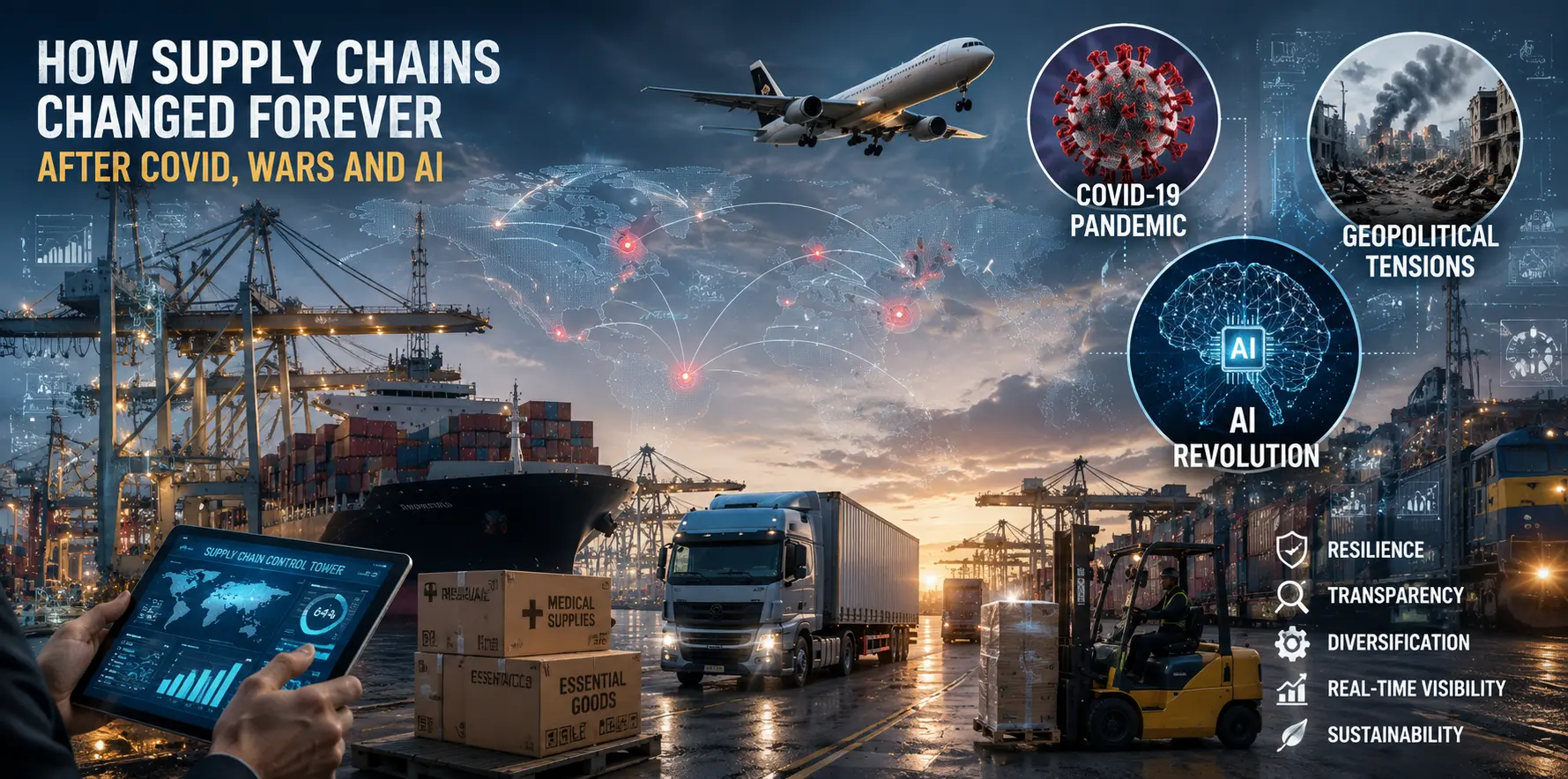

For decades, businesses measured supply chain success using three simple metrics: speed, efficiency and cost. Manufacturers kept warehouses lean, suppliers delivered components exactly when they were needed, and companies focused relentlessly on reducing inventory. The system worked remarkably well for almost forty years because it relied on one fundamental assumption—that global trade would remain stable.
Then COVID-19 changed everything.
Factory shutdowns, shipping delays and labour shortages disrupted production on an unprecedented scale. Automakers paused assembly lines because semiconductor chips were unavailable, retailers struggled to restock shelves and hospitals faced shortages of critical medical supplies. What had once been celebrated as an efficient global system suddenly appeared fragile.
The pandemic did not create these weaknesses. It simply exposed them.
Modern supply chains depend on thousands of specialised suppliers spread across multiple countries. A delay at one manufacturing facility can disrupt production thousands of kilometres away. Many businesses discovered they had only limited visibility beyond their immediate suppliers, making it difficult to anticipate problems before they reached customers.
The consequences were felt worldwide. Freight costs surged as ports became congested, shipping containers accumulated in the wrong locations and delivery times stretched from weeks to months. Consumers encountered empty shelves, lengthy waiting periods for new vehicles and shortages of products that had previously been taken for granted.
These disruptions prompted companies to rethink decades of supply chain strategy.
The traditional Just-in-Time model, which minimised inventory to reduce costs, is increasingly giving way to a more resilient approach often described as Just-in-Case. Instead of relying on a single supplier or maintaining minimal stock, businesses are building contingency plans, diversifying sourcing and holding strategic inventories of essential components.
Although this approach increases short-term costs, it reduces the risk of major operational disruptions when unexpected events occur. Increasingly, executives recognise that the cheapest supply chain is not always the most reliable one.
At the same time, geopolitical developments have become a major business consideration. Trade restrictions, export controls, regional conflicts and economic sanctions are now influencing investment decisions that were once driven almost entirely by cost. Supply chain resilience has evolved from an operational concern into a boardroom priority.
Semiconductors illustrate this transformation better than any other product.
Advanced computer chips power smartphones, cloud computing, artificial intelligence, electric vehicles, industrial machinery and modern defence systems. Because production is concentrated in relatively few locations, governments now consider semiconductor manufacturing a strategic national priority. Similar concerns have emerged around pharmaceuticals, battery technology and the critical minerals needed for renewable energy systems.
Rather than abandoning global trade, multinational companies are redesigning it. Many are adopting strategies such as supplier diversification, regional manufacturing and “China Plus One” production models to reduce dependence on a single country or region. The objective is no longer maximum efficiency alone, but a balance between cost, resilience and long-term stability.
Globalisation is therefore not disappearing. It is entering a new phase—one where flexibility, trusted partnerships and supply chain resilience are becoming just as valuable as low production costs.
Artificial intelligence is now becoming one of the biggest drivers of this transformation. Traditional supply chain management relied heavily on historical data, manual planning and experience. While those methods worked during relatively stable periods, they struggled to respond when consumer demand changed suddenly or unexpected disruptions occurred.
AI is changing that equation. Modern supply chain platforms can process enormous amounts of real-time information—from weather forecasts and shipping schedules to fuel prices, consumer demand and market trends—to identify potential risks before they become costly problems. Instead of reacting to disruptions, businesses are increasingly able to predict them.
Retailers can forecast demand more accurately, manufacturers can redirect production when suppliers face delays, and logistics companies can optimize delivery routes based on traffic, weather and port congestion. Warehouses are also becoming smarter through AI-powered inventory management, autonomous robots and computer vision systems that improve efficiency while reducing errors. Generative AI is beginning to support procurement teams by analysing supplier contracts, identifying operational risks and recommending better purchasing decisions. The future supply chain will not simply move goods more efficiently—it will make smarter decisions in real time.
Sustainability has also become a core part of modern supply chain strategy. Until recently, companies focused primarily on reducing costs and increasing speed. Today, customers, investors and governments expect businesses to demonstrate environmental responsibility alongside operational performance.
Manufacturers are investing in renewable energy, shipping companies are exploring lower-emission fuels and businesses are redesigning packaging to reduce waste. Many organisations are embracing circular economy principles by repairing, refurbishing and recycling products instead of following the traditional “make, use and discard” model. Digital technologies such as IoT sensors, blockchain tracking and AI-powered route optimisation are making these initiatives more practical while also improving efficiency and reducing operating costs.
For many companies, sustainability is no longer simply about corporate responsibility. Better energy efficiency lowers expenses, improved traceability strengthens consumer trust and diversified sourcing helps reduce the risks associated with climate-related disruptions. In the coming years, sustainable supply chains are likely to become the industry standard rather than a competitive advantage.
The next decade will continue to reshape how global commerce operates. Businesses are unlikely to abandon international manufacturing because global trade remains essential to economic growth. Instead, they are redesigning supply chains to balance efficiency with resilience, flexibility and digital intelligence.
Production is expected to become more regionally diversified, reducing dependence on any single country or supplier. Governments will continue investing in strategic industries such as semiconductors, pharmaceuticals, battery technology and critical minerals, while automation will expand across factories, warehouses and logistics networks. Companies will also gain greater visibility across every stage of their supply chains through connected digital platforms, enabling faster decisions and better risk management.
Perhaps the most important lesson from recent years is that resilience has become a competitive advantage. Businesses that can continue operating during periods of disruption are more likely to retain customer confidence, protect revenue and strengthen long-term relationships with suppliers and investors.
The future of global supply chains will not be defined by choosing between globalisation and self-reliance. It will be defined by finding the right balance between efficiency, resilience and innovation. Companies will continue operating across borders, but they will do so with more diversified sourcing, stronger regional partnerships and greater investment in technologies that improve visibility and decision-making.
Most consumers may never notice the AI systems forecasting inventory or the algorithms optimising international shipping routes. What they will notice is whether products remain available, deliveries arrive on time and businesses continue operating smoothly when unexpected challenges emerge.
Supply chains have always been the invisible foundation of the global economy. Today, they are becoming one of its most valuable strategic assets. In an era defined by technological disruption, geopolitical uncertainty and changing consumer expectations, the businesses that invest in smarter, more resilient and more sustainable supply chains will be the ones best prepared to compete in the global economy of tomorrow.