








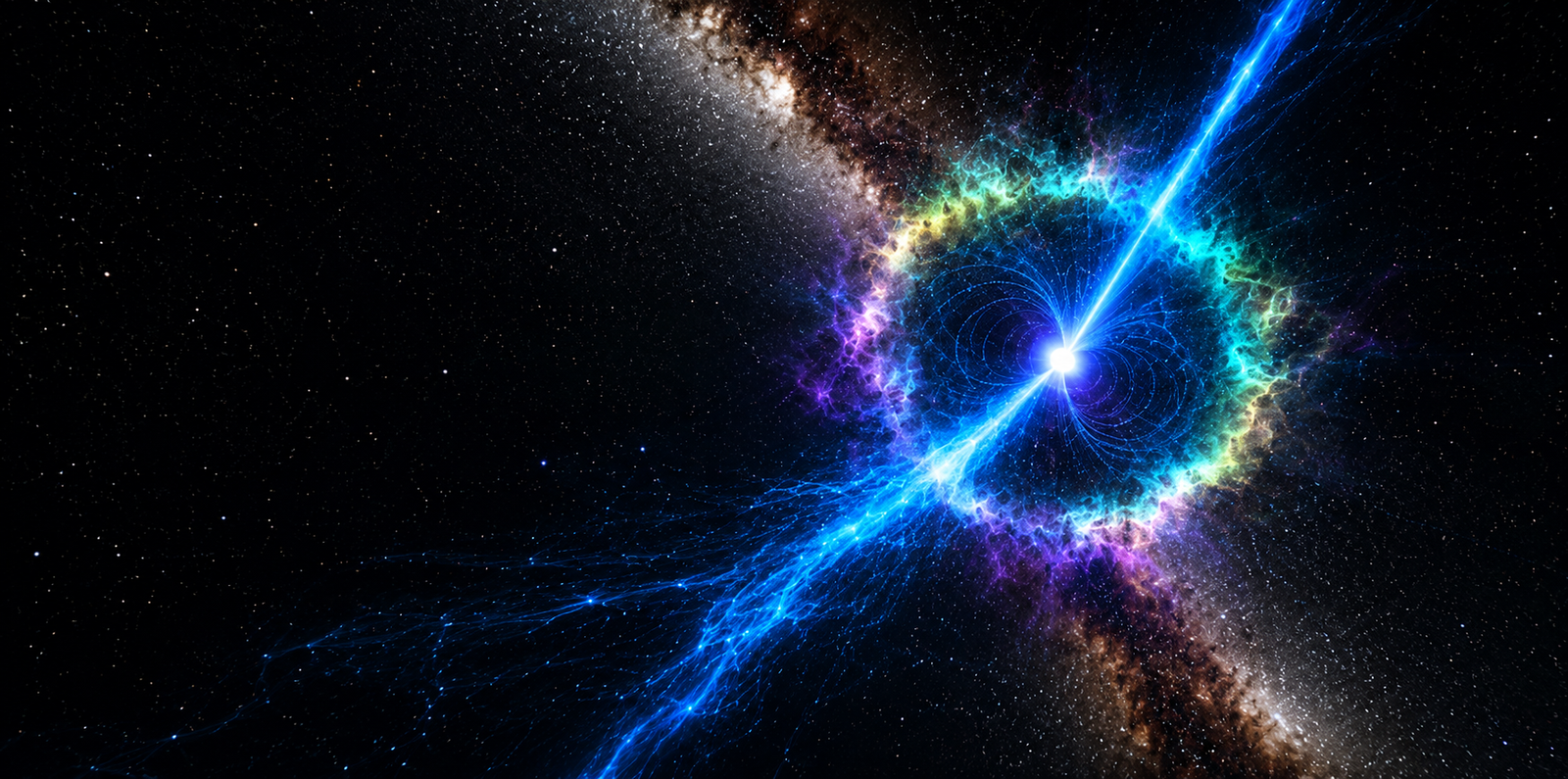

In Astrophysics, NASA has achieved a milestone by mapping the magnetic field which surrounds the Lighthouse Pulsar directly. Pulsar is providing compelling evidence, for the first time, for a theory that remained unconfirmed for nearly two decades. Scientists have observed how magnetic fields guide some of the highest-energy particles in the universe, using the Imaging X-ray Polarimetry Explorer (IXPE), which shows the behaviour of neutron stars and the extreme environments they create. This discovery is expected to reshape the understanding of researchers of how powerful magnetic fields accelerate particles to speeds approaching that of light, beyond confirming a long-standing scientific prediction.
The centre of the discovery is Lighthouse Pulsar, which is officially known as the PSR J1101-6101. It is an ultra-dense remnant, neutron star which is left behind when a massive star explodes in a supernova. Although only about the size of a city, the pulsar contains more mass than the Sun and spins an astonishing 16 times every second. Travelling through space at supersonic speed, it emits intense beams of radiation that sweep across the cosmos, earning it the nickname “Lighthouse Pulsar.”
The Pulsar is surrounded by the Lighthouse Nebula, which is an energetic cloud filled with charged magnetic fields and particles. Pulsar creates a powerful bow shock similar to the wave that forms in front of a speeding boat, when it moves through interstellar gas. Behind this shock lies a turbulent trail of high-energy particles, while an exceptionally long and narrow filament stretches far into space.
For years, astronomers believed this remarkable filament formed because the most energetic particles escaped the turbulent region and travelled along the Milky Way’s magnetic field lines. That changed when IXPE turned its attention toward the Lighthouse Nebula. During an observing campaign lasting nearly 18 days in June 2025, the spacecraft collected X-ray data from the faint structures surrounding the pulsar. Unlike conventional X-ray telescopes, IXPE measures the polarization of X-rays, allowing scientists to determine the orientation of magnetic fields in some of the universe’s most energetic environments.
As Lighthouse Nebula only emits faint X-rays, researchers developed a data-analysis technique that is capable of extracting exceptionally subtle signals. Scientists confirmed that the magnetic field runs parallel to the long X-ray filament. This alignment provides the strongest observational evidence yet that the highest-energy particles escaping the pulsar are indeed travelling along the galaxy’s magnetic field lines, exactly as theorists predicted in 2008.
Lead author Jack Dinsmore described the polarization measurements as the “smoking gun” needed to confirm the long-standing hypothesis. The results transform what had been an attractive theoretical explanation into a conclusion supported by direct observational evidence. The research also produced several unexpected discoveries that may prove even more important than the confirmation itself.
The remarkably high degree of X-ray polarization measured by IXPE. Scientists had expected the magnetic fields surrounding the pulsar to appear relatively chaotic due to the violent conditions generated by its rapid motion through space. Instead, the observations revealed a magnetic field that is significantly more organised than current theoretical models predicted.
According to co-author Roger Romani, this finding challenges many existing ideas about how particle streams develop around pulsars and suggests that the underlying physics may be more structured than previously believed.
A second discovery emerged when researchers compared the IXPE observations with radio data collected by Australia’s Commonwealth Scientific and Industrial Research Organisation (CSIRO). While the X-ray observations showed magnetic fields aligned with the long particle stream, the radio observations revealed magnetic fields oriented almost perpendicular to it.
This striking difference suggests that particles carrying different amounts of energy occupy separate regions around the pulsar and may be accelerated through entirely different physical mechanisms. Co-author Niccolò Bucciantini said the results provide the strongest evidence yet that multiple particle-acceleration processes are operating simultaneously within the same cosmic system.
To illustrate the discovery, NASA released a composite image combining blue X-ray data from IXPE, purple observations from the Chandra X-ray Observatory, green radio observations from CSIRO and an optical star field from the Two Micron All Sky Survey (2MASS). Together, the datasets create the most comprehensive view ever assembled of the Lighthouse Nebula’s magnetic environment.
Magnetic fields influence nearly every major process in the universe, from the birth of stars and galaxies to the behaviour of black holes and the production of cosmic rays.
The discovery also highlights the growing importance of X-ray polarimetry, a technique that allows astronomers to study magnetic structures that remain invisible to conventional telescopes. By measuring not only the intensity of X-rays but also the direction in which they oscillate, IXPE is opening an entirely new window into the high-energy universe.
The Imaging X-ray Polarimetry Explorer itself represents an international collaboration between NASA and the Italian Space Agency. Led by NASA’s Marshall Space Flight Center in Alabama, the mission also involves BAE Systems, the University of Colorado’s Laboratory for Atmospheric and Space Physics and scientists from 12 countries working together to explore some of the universe’s most extreme environments.
As astronomers continue analysing IXPE’s observations, the Lighthouse Pulsar is expected to become a cornerstone for future studies of neutron stars, magnetic fields and cosmic particle acceleration. What began as an attempt to verify a decades-old theory has evolved into a discovery that could reshape how scientists understand some of the universe’s most powerful natural accelerators.