






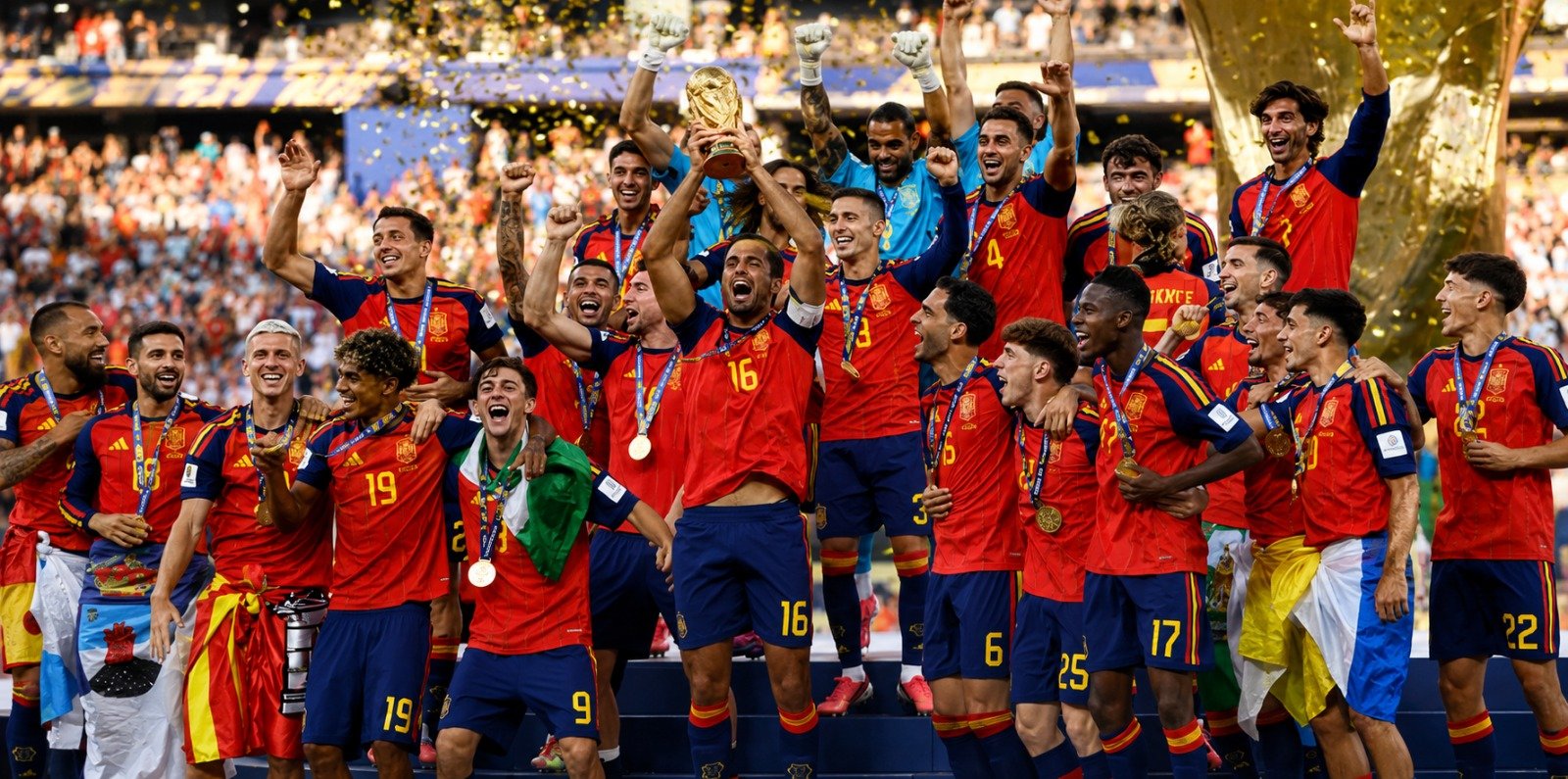

Spain defeated Argentina 1-0 following extra time in the FIFA World Cup and became world champion for the second time. In the 106th minute, substitute Ferran Torres scored a decisive goal, ending the hopes of Argentina of becoming the first nation since Brazil in 1962 to win back-to-back World cups.
The victory delivered Spain’s first world title since 2010 and confirmed the rise of a new generation that has blended technical control, tactical intelligence and defensive discipline. Entering the tournament as reigning European champions, Spain arrived with momentum, but their run through the competition exceeded expectations because of the authority with which they handled elite opposition.
The final was surrounded by an entertainment programme designed to turn football’s biggest match into a global cultural spectacle. Jennifer Hudson performed “The Star-Spangled Banner” before kickoff, Spanish Brass played Spain’s “La Marcha Real,” and Argentine singer María Becerra delivered the “Himno Nacional Argentino.” Post Malone, IShowSpeed, Robbie Williams, Nicole Scherzinger and Laura Pausini also appeared during the wider pre-match celebrations, while Tom Cruise introduced the two finalists to the packed stadium.
U.S. President Donald Trump attended the match alongside First Lady Melania Trump and was repeatedly booed by sections of the crowd whenever he appeared on the stadium screens. The reaction was heard during the national anthem and later during the trophy presentation, adding a controversial layer to an already highly watched final.
When the match began Spain immediately took control. Lamine Yamal broke through twice inside the opening five minutes, but Emiliano Martínez produced important saves to deny the young winger. The Argentina goalkeeper would go on to deliver one of the strongest individual performances of the final, repeatedly preventing Spain from taking an earlier lead.
Argentina struggled to establish any attacking rhythm during the first half. They reached the interval without recording a shot, earning a corner or managing a touch inside Spain’s penalty area. Their possession stood at around 35 percent, while Spain’s midfield controlled the pace and consistently recovered the ball before Argentina could build meaningful attacks.
Lionel Messi found little room to influence the contest. Rodri and Fabián Ruiz crowded the central areas, while Spain’s defensive line denied Argentina’s forwards the space needed to run behind. Argentina also suffered an injury setback before halftime when Lisandro Martínez was forced off and replaced by Nicolás Otamendi.
The interval brought the first dedicated halftime show in a men’s FIFA World Cup final, an 11-minute performance featuring Madonna, BTS, Justin Bieber, Shakira, Burna Boy, conductor Gustavo Dudamel, Chris Martin, the PS22 Chorus and characters from the Muppets and Sesame Street. Madonna opened with her 2000 hit “Music” alongside Brazilian football legends Ronaldo and Ronaldinho, before Dudamel and the Electric Mayhem performed “Seven Nation Army.”
BTS then performed “Dynamite” with a large dance group as supporters across the stadium sang along. Justin Bieber followed with an acoustic version of “Everything Hallelujah” after a playful introduction from Jason Sudeikis and Brendan Hunt appearing as their Ted Lasso characters. Shakira and Burna Boy restored the high-energy atmosphere with “Dai Dai,” the official song of the 2026 World Cup, accompanied by dancers and children. Chris Martin, Dudamel, the PS22 Chorus and familiar Muppet characters closed the show with a colourful message centred on unity and love.
Spain maintained control after the break. Martínez denied Pau Cubarsí, Pedri and Nico Williams as La Roja continued to create the better opportunities. Argentina coach Lionel Scaloni introduced fresh players in an attempt to change the momentum, while Luis de la Fuente reshaped Spain’s attack and eventually withdrew leading scorer Mikel Oyarzabal.
Argentina’s task became even harder when Enzo Fernández received a second yellow card and was sent off, leaving the defending champions with ten men. Spain responded by stretching the pitch and increasing the pressure around Argentina’s penalty area.
The breakthrough finally came in the 106th minute. Pedro Porro delivered a deep cross, Nico Williams headed the ball into the path of Ferran Torres and the substitute finished first time beyond Martínez. The goal made Torres only the second substitute in World Cup history to score the winner in a final.
The statistics reflected Spain’s superiority. La Roja outshot Argentina 20-2 and recorded an expected goals figure of 1.94 compared with Argentina’s 0.20. Messi finished with 54 touches and only one shot, underlining how effectively Spain neutralised the defending champions’ main attacking threat.
For Argentina, the defeat ended a historic title defence. Messi had described the tournament as his final World Cup, making the loss especially emotional. Even in defeat, one of the most admired moments came after the final whistle when Spain’s players formed a guard of honour for Messi and the Argentina squad as they collected their runners-up medals.
The presentation ceremony created further controversy when Trump joined FIFA President Gianni Infantino on the podium. Reports suggested Infantino and Spain captain Rodri attempted to move the ceremony forward so the players could begin celebrating. Official trophy-lift photographs later shared by FIFA and Spain largely excluded the U.S. president.
The final also carried political symbolism beyond the stadium. Spain’s support for Palestine and Lamine Yamal’s earlier display of a Palestinian flag had earned significant admiration in Gaza. Many residents reportedly supported Spain during the final, while Argentina’s perceived political closeness to Israel added another layer of public interpretation.