








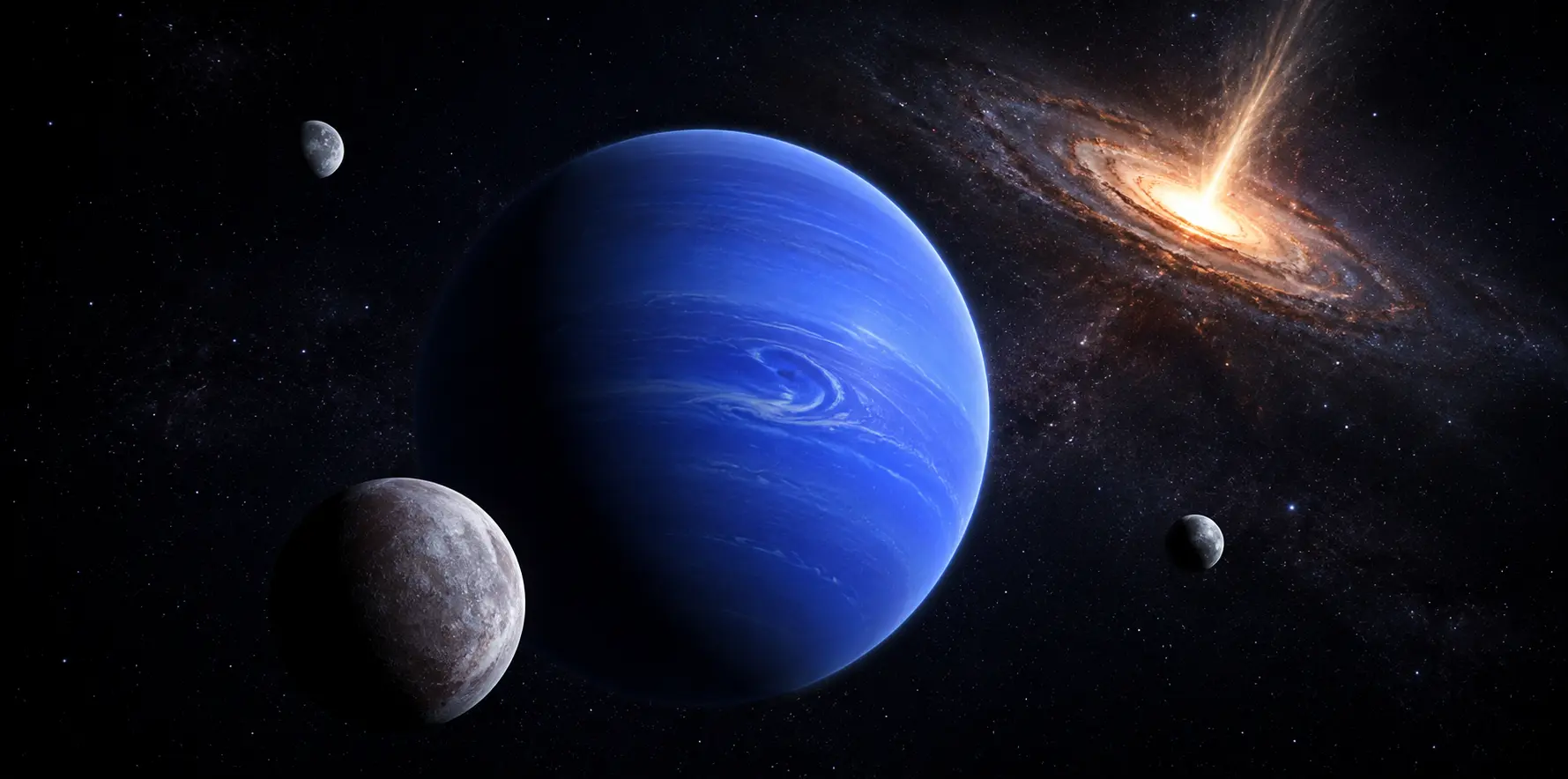

A new study in Science Advances proposes that Neptune’s faint rings and small inner moons are the remnants of a massive cosmic collision that occurred billions of years ago. Using observations from NASA’s James Webb Space Telescope (JWST), scientists found evidence that the planet’s current inner moons were rebuilt from the debris of an older moon system, which was destroyed after Neptune captured its largest moon, Triton.
The international research team used JWST’s Near Infrared Spectrograph (NIRSpec) in Integral Field Unit (IFU) mode to collect the first-ever infrared spectra of Neptune’s inner moons (Larissa, Galatea, and Proteus) and its faint rings. Instead of the expected water ice, researchers detected magnesium-rich clay minerals, known as phyllosilicates. These minerals typically form only after long-term interaction between liquid water and rock.
Given that Neptune’s present-day inner moons are too small and cold to support underground oceans or prolonged geological activity, scientists concluded that the clay minerals could not have formed on the moons themselves. Instead, they believe the material originated deep inside much larger icy moons that once orbited Neptune before their destruction.
According to the study, this chain of destruction began billions of years ago when Triton, a Kuiper Belt object, was captured by Neptune. Triton entered a highly unstable retrograde orbit, and its powerful gravitational influence disrupted Neptune’s original moon system. This triggered a long period of violent collisions that shattered many of the planet’s early satellites. Researchers estimate that only about 1 percent of the debris remained in orbit, eventually coalescing to form Neptune’s current inner moons and rings.
These findings provide scientists with a rare opportunity to study the hidden interiors of ancient icy worlds, which are normally buried beneath thick layers of ice. The catastrophic collisions exposed material from deep inside the lost moons, allowing researchers to analyze their composition for the first time.
Beyond explaining the origin of Neptune’s inner moons, the discovery offers new insight into how a single gravitational event can completely reshape an entire planetary system. Scientists say the study improves our understanding of the violent evolution of the outer Solar System and highlights the powerful role that collisions played during its early history, making it one of the most significant discoveries yet from the James Webb Space Telescope.